There’s something seductive about the edge of the map.
We talk about remote places the way earlier generations spoke of monasteries or islands—as if distance itself confers virtue. Move far enough away, we think, and life simplifies. The noise drops out. The clutter burns off. What remains must be purer.
I live in the high desert of northern New Mexico, where the horizon is far, and the light is unfiltered and unapologetic. Bands of wild horses wander through. At night, the sky does not glitter—it stares. Out here, remoteness feels medicinal, therapeutic. It promises clarity. It whispers that the rest of the world can’t quite reach you.
But that whisper is a little dishonest.
We romanticize remote places because they flatter our belief in reinvention. We imagine the mountains as absolution, the desert as eraser. History may have happened back there, in the city, in the old neighborhood, in the life we outgrew. Out here, we tell ourselves, we can begin again.
That’s an old American story. It built cabins and communes and whole states like Wyoming, where I grew up. It also built myths. Because geography changes your address, not your nature.

COMING MAY 5
Classical mystery writers understood something similar about confinement. In the great locked-room puzzles—the manor sealed by snow, the train stalled by a storm, the island cut off by tide—the crime cannot float in from elsewhere. The killer cannot arrive late or slip away unseen. The door is bolted. The bridge is out. The suspects are introduced early and remain within reach of the reader’s suspicion.
We love those stories because they impose boundaries. They promise fairness. The culprit is here. Among us. If we are observant enough, disciplined enough, clever enough, we can solve it. The world may be chaotic, but inside these walls—inside this snowbound estate—there are rules.
Remote places seduce us with the same promise.
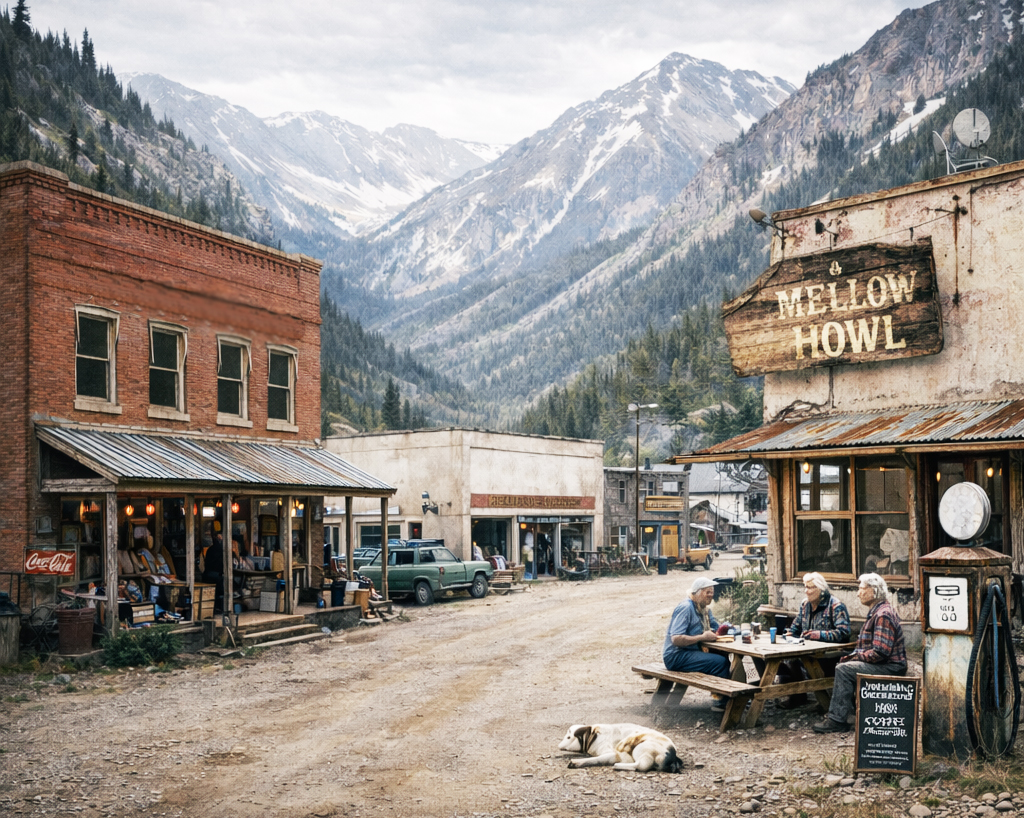
A quirky mountain village like the fictional Deep End in my new mystery DEEP END feels like a locked room on a grand scale. One road in. One road out. Everyone visible. Everyone known. Surely nothing can happen here that doesn’t belong here. Surely the danger would have to come from within.
And there’s the catch.
Isolation doesn’t prevent human complexity; it concentrates it. When you live in a remote place like, say, Wyoming, you don’t escape other people—you encounter them more intensely. There are fewer of them. Their stories overlap. Their pasts are harder to misplace. If something fractures, the echo lingers.
In the desert, there are no alleys to disappear into. But there are arroyos, and memory, and long grudges in the air. Silence does not erase conflict. It amplifies it. Out here, you hear your neighbor’s truck from miles away—and sometimes you hear your own thoughts just as clearly.
I’m drawn to such places in life for the same reason I return to them in fiction. They narrow the frame. They force accountability.
In my upcoming mystery novel, the remote mountain village of Deep End sits high and self-contained (inspired by eccentric Madrid NM), populated by aging idealists who once believed they could outpace the world. Not far away lies the small town of Midnight CO—a fictional echo of Idaho Springs, where I once lived—another place where everyone thinks they know everyone. These are communities that feel finite, knowable. In storytelling, that containment sharpens motive and consequence; in real life, it sharpens character. You can’t vanish into anonymity. You are seen. And being seen, whether you like it or not, is clarifying.
We romanticize remote places because they feel finite. Contained. Like a story with a manageable cast. We can name the players. We can trace the motives. We can convince ourselves that if trouble comes, we’ll recognize it immediately because it must already be in the room.
But every locked-room mystery eventually reveals the same unsettling truth: the threat was never outside the walls. It was sitting at the dinner table. It was smiling across the fire. It was introduced in chapter one.
Remoteness offers beauty. Perspective. A kind of bracing honesty. I would not trade my New Mexico horizon for much. But it does not absolve us. It does not filter out human frailty. It simply narrows the stage and turns up the volume.
Which may be why we love it.
In a world that feels sprawling and uncontainable, we crave a setting—whether it’s a snowbound manor or a high desert village—where the boundaries are clear and the suspects are few. We want to believe that if we close the door tightly enough, we can see the whole truth.
We forget that the door locks from the inside.