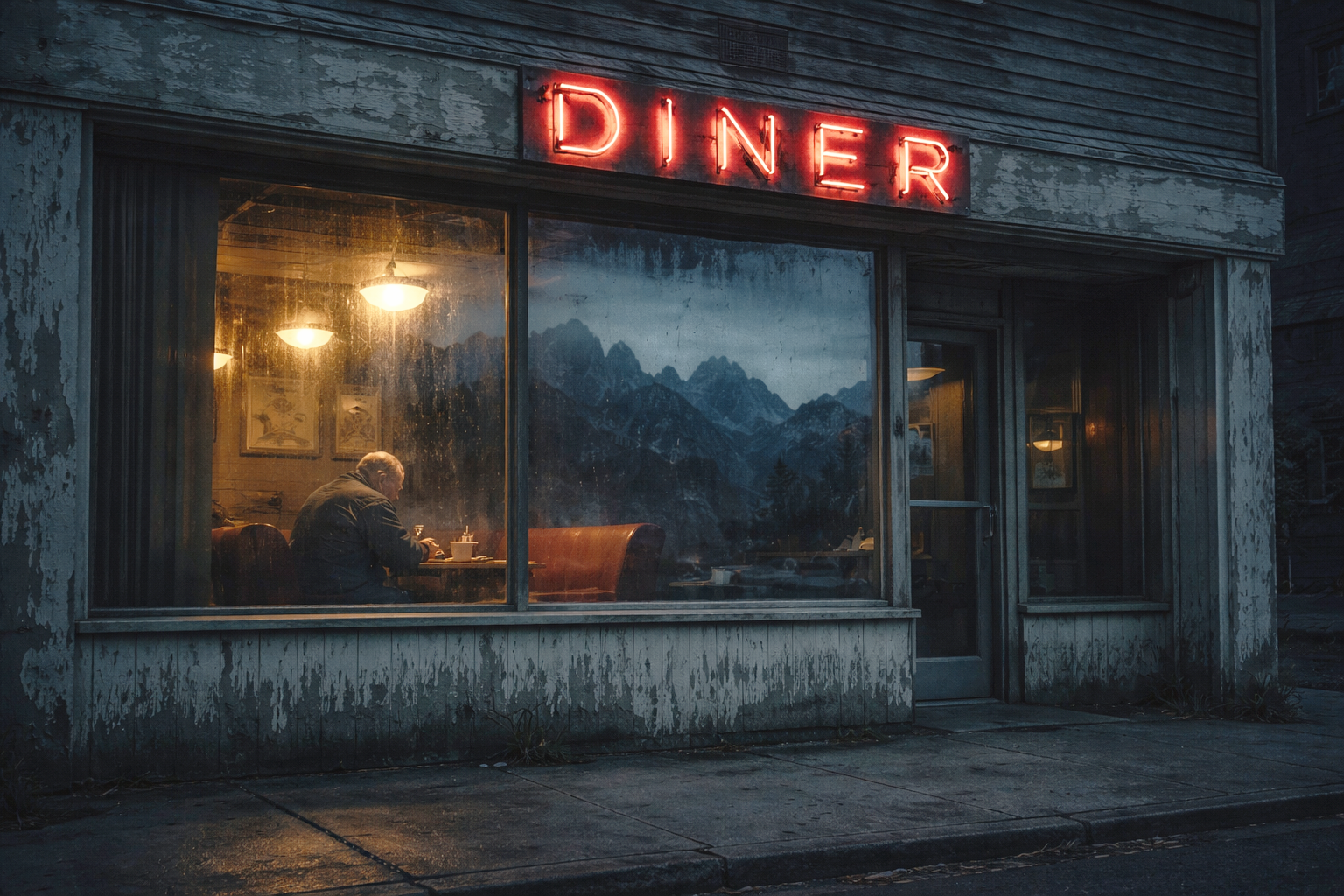
We have a mythology about small towns in America, and it goes something like this: people know each other, watch out for each other, leave their doors unlocked at night. Life moves slower, values run deeper, and the land itself is a kind of moral anchor. It’s a pretty story. It’s also, in my experience, mostly horseshit.
I grew up in the American West, and I’ve spent a career as a crime writer and journalist watching darkness grow in the most unlikely places—places where everybody knows everybody, where there’s one stoplight and one church and one cop, and where secrets don’t disappear into the anonymity of a city. They fester. That’s the truth “rural noir” is built on. I hadn’t heard the term before writing DEAF ROW and DEEP END, but then a reviewer cited my mystery as a great example of it. Go figure.
 Noir is a French word for “black,” but as a literary term it means something more specific than darkness. It means a particular worldview—one that Chandler, Hammett, and James M. Cain codified in the mid-20th century and that has never really gone out of fashion, because the worldview itself has never stopped being accurate. In noir, the universe is not merely dangerous—it is indifferent, possibly rigged, and corruption isn’t a malfunction of the system. It is the system. The protagonist is rarely clean. He is compromised, fatalistic, morally smudged around the edges, carrying the weight of choices he made and choices that were made for him. He moves through an atmosphere of dread that goes deeper than any particular danger—it’s the dread of knowing how things tend to turn out.
Which is why the ending of a noir story almost never feels like triumph. Justice arrives partially, or ambiguously, or not at all. The detective doesn’t restore order—he survives it, barely, and moves on to the next thing that will cost him something. Noir is, at its core, a pessimist’s literature. And yet readers return to it obsessively, perhaps because it confirms what we quietly suspect: that the world is not arranged in our favor, and that the best a decent person can do is keep moving through it with something like integrity intact.
The term “noir” carries the weight of rain-slicked city streets, corrupt precincts, and doomed men in fedoras. Chandler’s Los Angeles. Cain’s moral sewers. The city as labyrinth. But noir was never really about geography—it was always about worldview. The literary conviction that evil isn’t aberrant, that institutions can be rotten at the core, that justice—when it arrives at all—tends to arrive incomplete and at great cost. Strip away the urban backdrop, and that worldview transplants to rural America with terrifying ease.
Maybe more ease, actually.
When I put Woodrow “Mountain” Bell in the Colorado Rockies, in a dying mining town called Midnight, I wasn’t looking for picturesque. I was looking for pressure. The mountains around Midnight aren’t majestic backdrop—they’re walls. They limit access, they swallow sound, they keep the outside world at a comfortable remove, which is exactly what someone trying to hide something wants. Bell himself came to Midnight for that reason. A retired Denver homicide detective haunted by Vietnam and by decades of witnessing the worst humanity can do to itself, he wanted the mountains to wall out his old worlds. What he discovered is that the darkness followed him—because darkness doesn’t originate in cities. It originates in people, and people are everywhere.
Midnight is the kind of town the American West is full of: a one-time mining settlement barely clinging to life, where the economic engine died a generation ago and left behind people who were too stubborn, too poor, or too deeply rooted to leave. There’s a specific kind of desperation in such places—not the urgent, kinetic desperation of cities, but a slow, grinding kind that becomes the water everyone drinks. When that desperation curdles into crime, there’s no robust institution to address it. No forensics lab, no specialized unit, no backup two minutes away. There’s what’s there, which is usually very little.
For Bell, what’s there is a handful of old men at a corner table in the Tommyknockers Diner—named for the grizzled mine spirits of Colorado legend, those unseen presences that miners swore could be heard knocking in the deep dark, warning of cave-ins or leading toward paydirt. They call their table Deaf Row: a retired priest, an old newspaper editor, a former doctor, a disgraced fire chief, a couple of tired old teachers. Men whose particular experiences of the world turn out, again and again, to constitute something like a forensic team without the science—and without the budget. They are, in their way, the institutional infrastructure that Midnight lacks. Grizzled, increasingly invisible to the wider world, stubbornly, ornately present.
That invisibility is itself a rural noir theme. In cities, the marginalized are visible enough to be politically inconvenient. In small towns, the vulnerable—the poor, the old, the Indigenous, the forgotten—can simply disappear into the landscape, and often do. Nobody files a report. Nobody holds a press conference. The mountains don’t care, and neither, frequently, does anyone with authority.
What rural noir does, at its best, is refuse the mythology. It looks at the small town not as refuge from modern darkness but as a place where darkness has had generations to take root, undisturbed and unexamined. Craig Johnson understands this. So do CJ Box, and Tony and Anne Hillerman. The land in their books is beautiful, yes—but it is not kind. Community in their pages is real, but it is also a mechanism of complicity, a way of deciding together what not to see.
Bell would understand that instinctively, even if he’d never use the phrase “rural noir” in his life. He came to Midnight to escape. He found instead that mountains keep secrets the same way cities do.
They just keep them quieter.