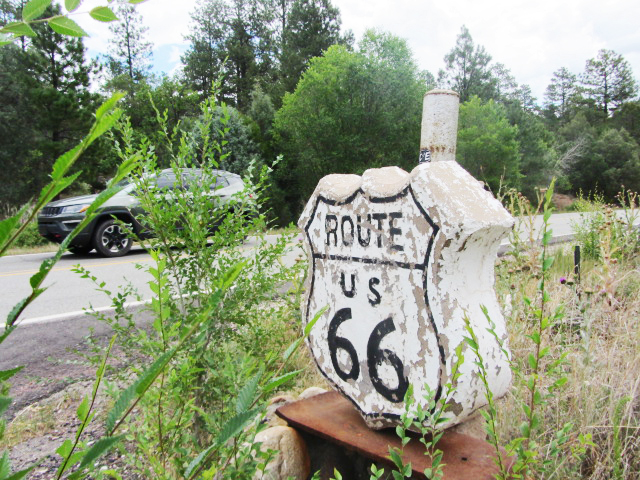
“How can we live without our lives? How will we know it’s us without our past?”
― The Grapes of Wrath
This year, we celebrate the 100th anniversary of Route 66, a road that doesn’t really exist anymore except in literature and legend. But of course, asphalt doesn’t vanish when history changes its mind. It’s just less traveled.
For the first decade of its life (1926-1937) the original Route 66 between Santa Rosa NM and Albuquerque ran boldly north around the mountains to Santa Fe before turning back south again. It was a crooked elbow in the nation’s most famous highway, less efficient, perhaps, but human in its logic. Roads once followed the places people already loved—capitals, courthouses, trading posts, rivers—and avoided impediments, namely mountains.
So yesterday, my wife and I struck out to find whatever ghosts remained on this “lost” road, still known as the “Santa Fe Loop.”
This is also the road taken by the Joad family in John Steinbeck’s great novel “The Grapes of Wrath.” Steinbeck contrasts the beauty of this northern New Mexico stretch with the Joads’ inability to enjoy it. They are focused entirely on food, gasoline, money, and keeping the car moving, so the scenery becomes almost ironic: magnificent mountains surrounding people trapped by poverty.
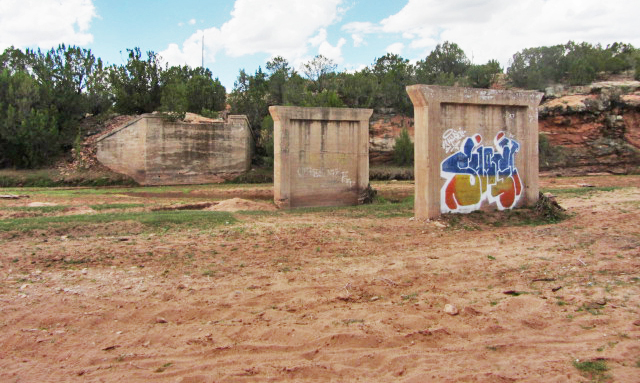
Old Route 66 bridge abutments in Tecolote NM
Steinbeck’s story might last forever—this particular piece of the Mother Road didn’t. In 1937 engineers straightened Route 66. The new route cut directly west from Santa Rosa through the mountains to Albuquerque, shaving off more than 50 miles, reducing the time and gas travelers needed during the Depression.
Today, that original “Santa Fe Loop” is a faded memory. What little remains lies under or adjacent to US Route 84 and NM50, between Santa Rosa, NM and Santa Fe NM, now backroads connecting the superslabs of Interstate 40 and Interstate 25. Some abandoned bridge abutments, a few patches of old asphalt, and some private farm lanes are all that actually remains of this original stretch of Route 66. Most travelers pass within miles of it without ever suspecting that, once upon a time, the Mother Road bent this way.
Out here, the old Route 66 has mostly dissolved back into dust and memory, its asphalt surrendered to weeds, wind, and the long amnesia of progress. What remains are the towns it briefly animated, strung like forgotten beads along a road that no longer quite exists. Some still lean toward the past, coaxing a few reluctant dollars from the ghost of Route 66 with sun-faded signs and stubborn nostalgia, as if the Mother Road might yet remember them and return. Others seem to have exhaled, no longer rattled by hopeful travelers, owing and expecting nothing to passing traffic.
In these places—Dilia, Romeroville, Bernal, Tecolote, Pecos, Glorieta, Algodones, among other far-flung villages—the road is gone but not entirely lost. The idea of it lingers, even if remnants are few.
There are still the old bridge abutments across the dried-up Pecos River in tiny Tecolote and Dilia. Abandoned gas stations, diners, and mercantiles haunt the blacktop. Old road signs along the way are more quaint than historic. And there are odd bits of modern-day marketing, like gift shop T-shirts and Christmas ornaments.
This isn’t my first dance with the road. In 2001, on the 75th anniversary of Route 66, I chased the road—not just its pavement, but its pulse. At the time I was a senior writer for the Denver Post, and my assignment was, in effect, to understand how a road becomes a legend. I ended up telling much of that story through the journals of a few Oklahoma teenagers who, in the 1950s, had piled into a car and lit out west on their own Mother Road adventure. Their voices were young, impulsive, hopeful in the way only teenagers can be, but they understood something essential: a road trip is rarely about geography. It’s about possibility. The horizon keeps moving away from you, and with it goes the sense that your life is locked into one place or one version of yourself.
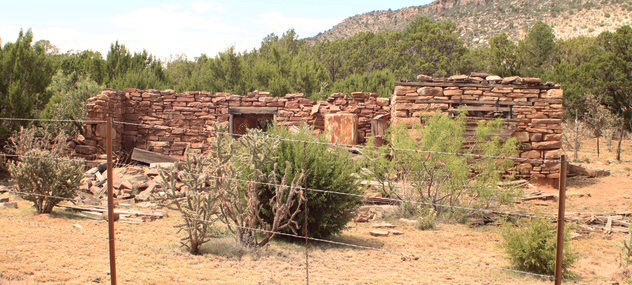
Roadside ruins beside NM84
That idea had already been growing on me through the thousands of miles I drove while covering the evolving American West for the Post—long stretches of highway through Wyoming wind, Nevada heat, New Mexico silence. Roads, I discovered, have a peculiar therapeutic quality. Maybe it’s the motion, or maybe it’s the reminder that landscapes—and lives—are always in transition.
Roads, like lives and ideas, are mutable. Every generation redraws them according to its own priorities—commerce, speed, safety, ambition. What once seemed the obvious path eventually becomes the scenic one, then perhaps the unnecessary one.
Surveyors’ lines across a map look permanent, but when a straighter pass is found, when time becomes more valuable than distance—the road shifts, abandoning yesterday’s logic for today’s urgency. But the older path lingers, a reminder that each generation finds its most sensible way forward.
The forgotten routes of America remind us of something the interstate system tries hard to deny—that the point of travel was never just getting there. It was the wandering line we drew across the map while we were figuring out where “there” even was.