For a true-crime writer, the world is seldom what it seems. Every place hums with a past life; every peaceful landscape casts a longer, darker shadow.
When I moved to Placitas, New Mexico—a sun-splashed village tucked against the ragged spine of the Sandias—I suspected as much. I didn’t expect that one of the funkiest, most unsettling stories of my career had unfolded literally just up the road from where I sleep.
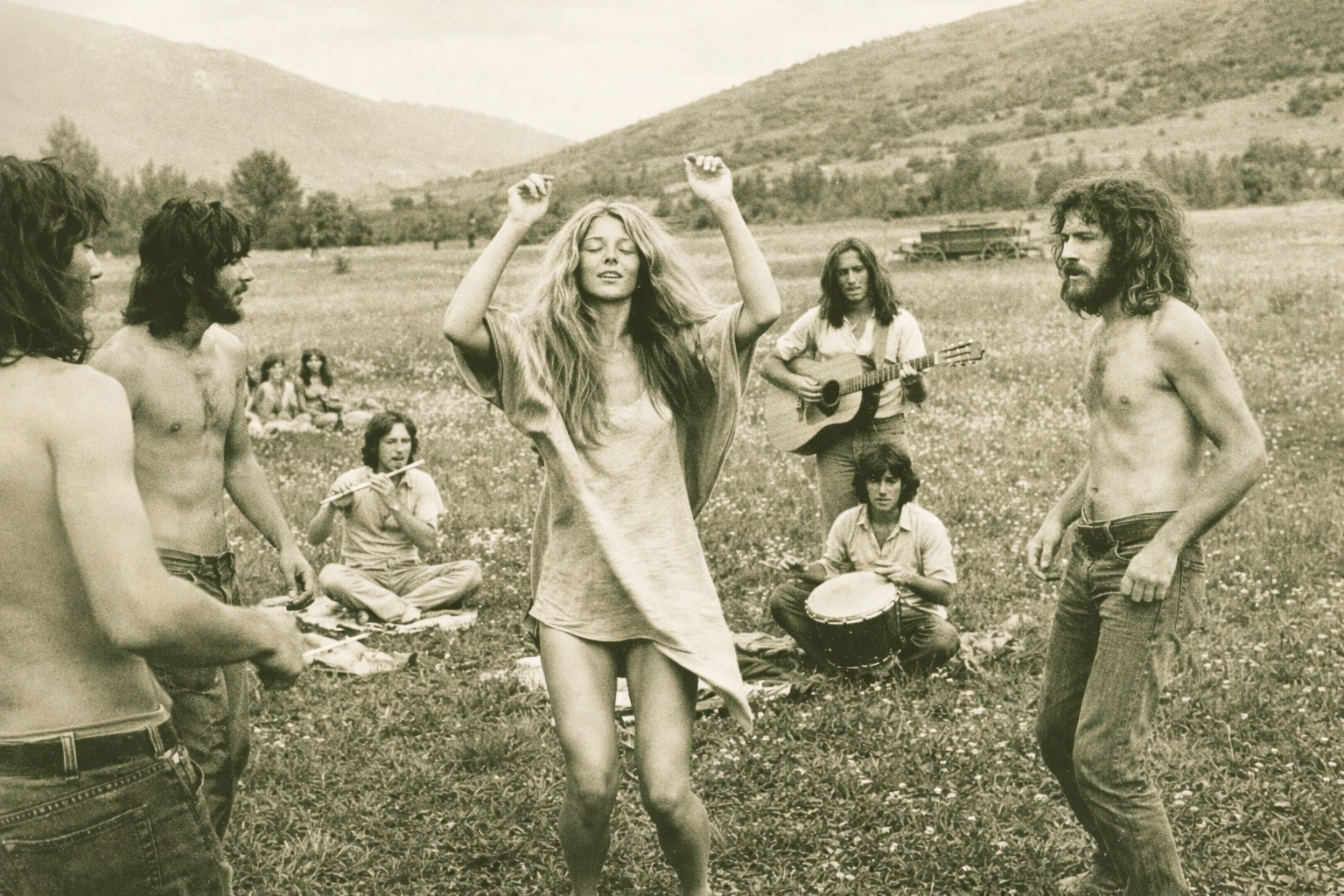
In the late 1960s and early ’70s, Placitas was, improbably, a waypoint in the counterculture—a scattering of communes with hopeful names like Lower Farm and Domesa, where young people came chasing freedom, simplicity, a return to the land. Raggedy-ass geodesic domes shuddered in the wind. Music around fires. Dancing naked. Gardens clawed out of stubborn sand.
And then the dream cracked.
Just before Christmas 1970, at one of those communes, a man who fancied himself the reincarnation of Ulysses S. Grant picked up a gun. In a matter of minutes, two men were dead, another wounded. The fragile utopia collapsed into blood and panic. The shooter vanished into the desert, as if swallowed by it. I wrote about the crime years later, trying to pin it down. Here’s what I wrote in 2020 about the double murder.
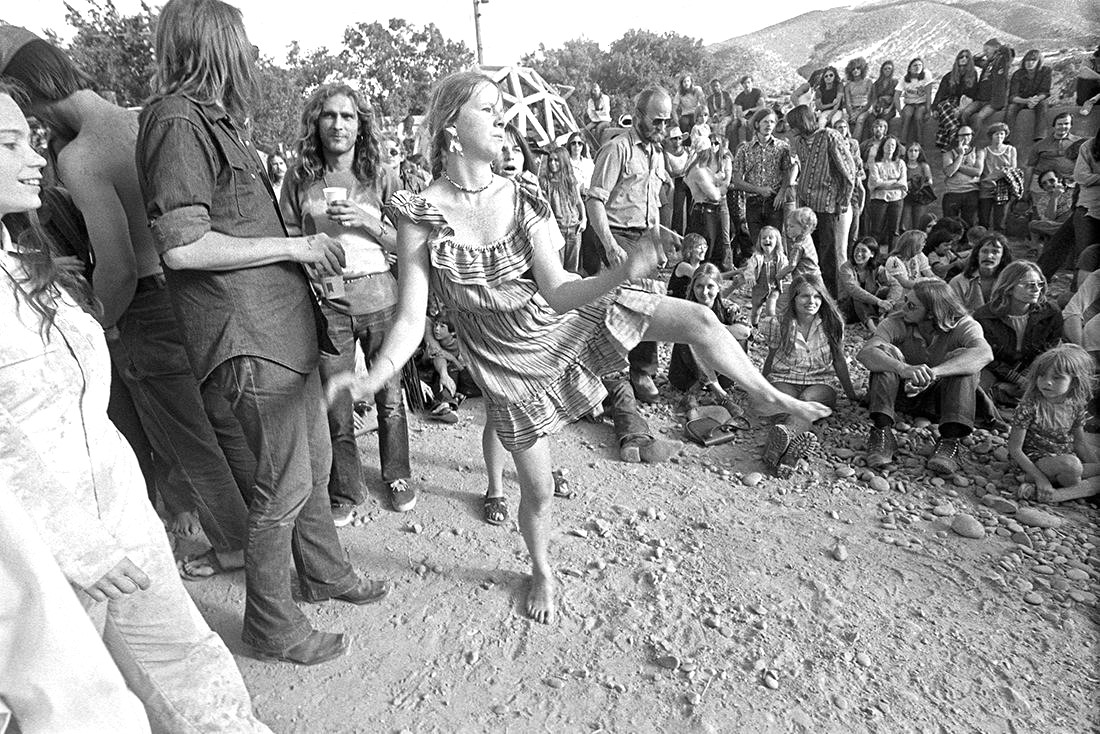
Hippie gathering in Placitas, 1972
But it wouldn’t stay pinned.
The facts were there, fixed and stubborn, but the story frayed at the edges. Beneath it all ran something sadder. The official version told me what happened (although most official records of the investigation have been lost), but not what it felt like to live there in those final, uneasy days, when the promise of something better began to rot from within.
What stayed with me most were the victims. Not the spectacle of the crime, not the bizarre mythology around the killer—but the men who died. It is far too easy, in stories like this, for the dead to become scenery, their lives reduced to brief identifiers in someone else’s madness. One of them—a bona fide war hero who was literally in the wrong place at the wrong time—survived combat only to be murdered in a place that promised peace. And then, in a final indignity, his body was literally lost by the undertaker. Even in death he couldn’t find his way home. I found myself imagining who he had been before that desert winter, what he thought he’d found in that fragile community, and how abruptly it was taken from him. I couldn’t ignore that interruption, two lives cut mid-sentence.
So I turned to fiction to tell it.
In DEEP END, I moved the bones of that story north, into the Colorado Rockies, where my old codgers of Deaf Row could find it. Snow instead of dust. Pine instead of juniper. But beneath that shift in landscape, much of the actual true crime remains—sometimes more intact than readers might expect. Real names. Real tensions. Real, unsettling facts that refused to let me go.
Because fiction, paradoxically, allowed me to be more honest. In nonfiction, you are bound to what can be proven. In fiction, you are bound to what feels true. You can step into the silences, inhabit the contradictions, and follow the emotional currents that facts alone can’t quite trace.
The result is a story that lives in both worlds. Not a retelling, not an invention, but an excavation—of memory, of myth, of the fragile human impulses that can turn idealism into something dangerous.
I’ve always believed that true crime is, at its core, about storytelling. It shouldn’t be a tedious recitation of facts. It should illuminate something essential about who we are. Facts alone rarely tell that whole story. There are always missing pieces, emotional undercurrents, unanswered questions.
DEEP END, a fiction, is my way of filling those gaps. In the process, it becomes something larger—a meditation on the stories we tell ourselves about who we are, and how quickly those stories can unravel.
The real-life crime that inspired it still lingers. It belongs to a specific place and time, yes—but it also belongs to something larger, something universal. The impulse to believe. The impulse to control. The ease with which a dream can fracture.
And even in the most beautiful places, darkness finds a way in.
Photo above of outdoor hippie gathering in Placitas by Robert D’Alessandro ©1972, courtesy of the New Mexico History Museum/Palace of the Governors photo archive