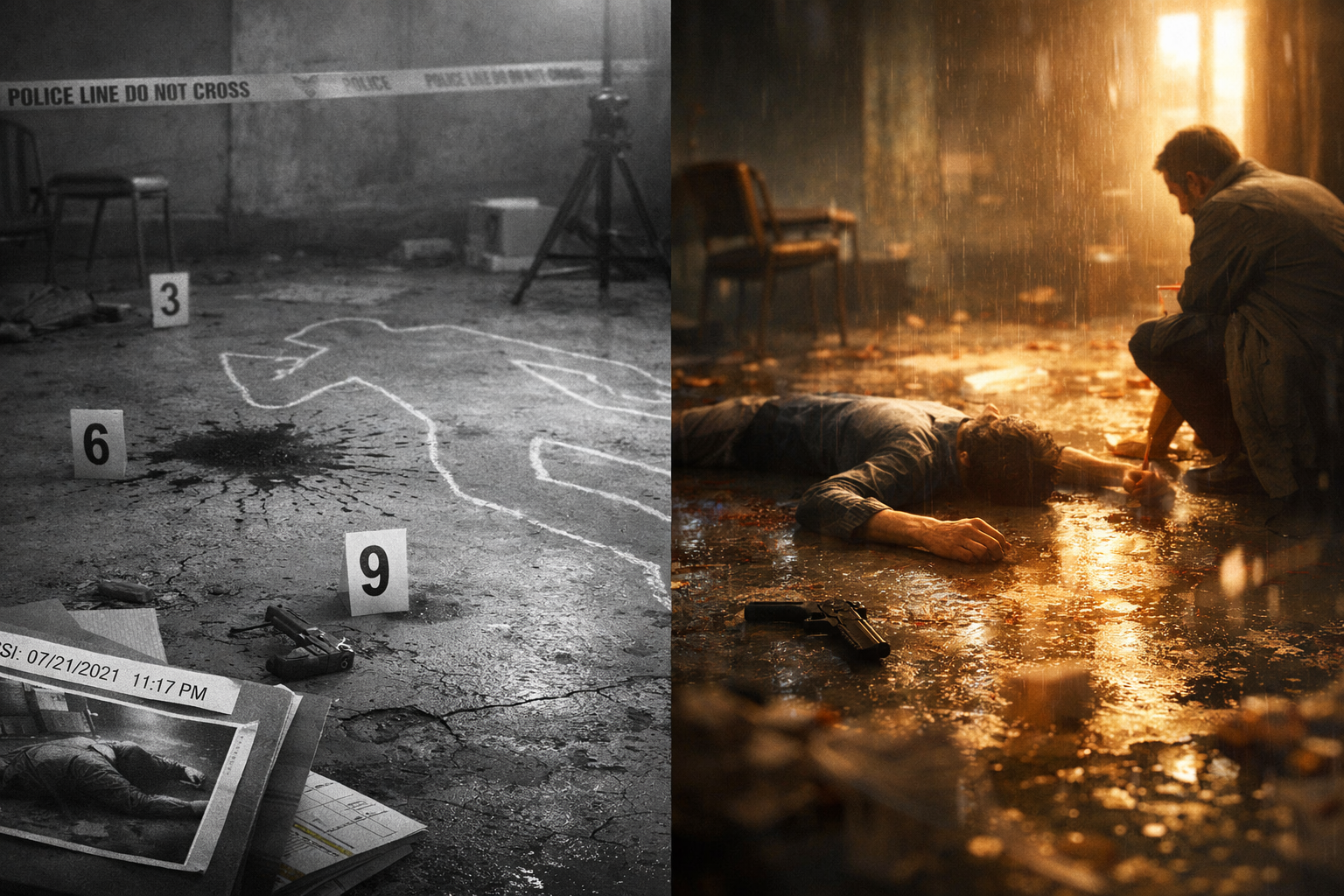
Writers like to pretend stories are found objects—arrowheads in the dust, waiting for the right set of eyes. We talk about stumbling onto them, as if narrative were a vein of ore and we’re just the lucky ones holding a shovel.
But that’s a comforting fiction.
Because most of the stories that matter—especially, but not confined to true crime—don’t lie around unclaimed. They belong to someone. Often to many someones. Victims and their families. Investigators. Witnesses. Even perpetrators, in their own warped way. A real story is less like an arrowhead than a piece of evidence, still warm to the touch.
In my upcoming mystery DEEP END, I didn’t invent the crime so much as lean into it. I wrote earlier about the true crime that inspired the story. As with Book #1 in the series, DEAF ROW, the fictional bones come from a real case file, and I kept a lot of it intact: authentic details, unvarnished moments, even many of the real names. What I changed, I changed with purpose—compressing where life meanders, rearranging where truth arrives out of order. It’s a lightly fictionalized telling, but not a casual one. The aim wasn’t to improve on the messiness of what happened so much as to understand it.

Coming May 5
(Disclaimer: Not every mystery writer works this way. Many—maybe most—create their crimes from whole cloth, fully imagined. My path is different, shaped by a journalism and true-crime background that keeps pulling me back toward real case files. I begin with what actually happened, then reshape it into fiction that can carry what the original record couldn’t quite hold.)
But in the end, much of it really happened to real people.
So who gets to tell it?
Journalists have one answer: whoever can verify it. The facts, once established, are public record. That’s the bargain. But even then, access is not ownership. The telling carries weight. Tone matters. Emphasis matters. What’s left out matters just as much as what’s included.
I’ve played both sides of that literary field. Fiction writers operate under a different license, and perhaps a more dangerous one. We borrow freely. We compress timelines, merge people, invent motives. We rearrange the furniture of reality until it better suits the architecture of a story. We tell ourselves that the act of transformation makes it ours.
Sometimes it does. Sometimes it doesn’t.
There’s a moment that comes when you’re working with material drawn from real harm—a moment when the work stops feeling like craft and starts feeling like you’re trespassing. You recognize a detail that didn’t originate with you. A gesture, a grief, a fragment of someone else’s worst day. You can dress it up, rename it, relocate it, but the emotional truth remains intact. It’s still theirs.
That’s the line that doesn’t stay put.
We can argue, as writers often do, that stories are how we make sense of the world. That shaping chaos into narrative is not just an artistic act but a human one. Fair enough. But that doesn’t grant immunity from responsibility. If anything, it heightens it. To take someone else’s experience—especially their suffering—and turn it into story is to assume a kind of quiet authority over it.
The question isn’t just “Can I tell this story?” It’s “What happens if I do?”
Does it illuminate something real, or does it simply repurpose pain for momentum? Does it honor complexity, or sand it down into something more convenient? Does it make room for the people at its center, or does it replace them with more manageable versions?
These aren’t questions with clean answers. They’re questions you carry.
For me, the only workable approach has been a kind of deliberate distance—not from the emotional core of a story, but from its specifics. To resist the urge to replicate. To let the facts fall away until what remains is the question that first drew me in. Not the who or the where, but the why. Not the event, but the echo it leaves behind.
At that point, the story begins to shift. It stops belonging to any single person or moment and becomes something else—a conversation, maybe, between what happened and what it means. That’s the space where fiction can do its best work. Not by claiming ownership, but by acknowledging its limits.
Because in the end, no matter how cleanly a story is told, it never fully belongs to the teller. It carries the weight of its origins, whether visible or not. The best we can do is handle it with care, aware that we are always, in some sense, holding something that was once—and may still be—someone else’s.
Pre-order DEEP END now
Coming May 5 wherever you buy books